Hi, I’m Amin.
I work on robots and AI — computer vision, eye tracking and control of real machines — and on explaining what a model has learned.
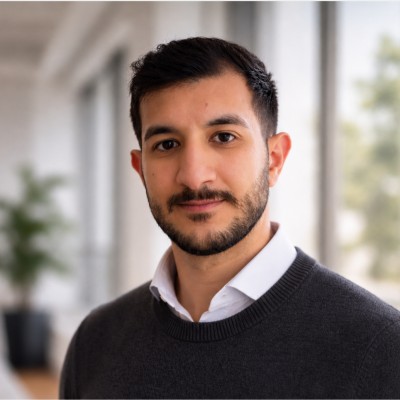
At the moment I am a master’s student in Automation and Control at RPTU Kaiserslautern, writing my thesis with Fraunhofer IOSB and KIT on explaining graph neural networks. A prediction is only worth acting on if you can see why it was made — and on a graph, where what the model has learned is spread across the structure rather than sitting in any one place, saying what a prediction rests on is harder than it sounds.
I came to this from mechanical engineering, by way of a robotics lab — where the work on a paraplegic exoskeleton became my first paper — and four years building software professionally. I came back to research because the questions I could not put down were in machine learning, perception and control, and the engineering habits came with me: I write research code that other people can actually run.
2014 · Mashhad
B.Sc. Mechanical Engineering
I started a degree in mechanical engineering at Ferdowsi University of Mashhad, and with it the mechanics and control that the rest of this route builds on.
2017 · Mashhad
Adaptive control of a lower-limb exoskeleton
As an undergraduate research assistant in the FUM Robotics Research Lab, I designed an adaptive controller for a lower-limb exoskeleton for paraplegic users, and tested it on the physical robot. The work became my first paper, at ICRoM 2019.
2019 · Mashhad
Bachelor thesis
I graduated with a thesis comparing LQR, PID and fuzzy control on an under-actuated double inverted pendulum: two joints to hold upright, and a motor at only the second.
2019–23 · Remote
Four years in front-end development
I moved into industry as a front-end developer, working remotely for companies in Vancouver and then in Spain. The engineering habits came with me when I went back to research.
2023 · Kaiserslautern, Germany
M.Sc. Automation and Control
I began a master's in Automation and Control at RPTU Kaiserslautern, specialising in Connected Automation Systems.
2024 · Walldorf, Germany
Working student at SAP
Alongside the master's, I spent two years as a working student developer at SAP, on its Cloud Application Programming model.
2024 · Kaiserslautern, Germany
Gaze-based activity recognition at DFKI
At the German Research Center for Artificial Intelligence I worked on recognising what people are doing from where they look. For my master's project I designed and ran a study with HoloLens 2 eye tracking in the DFKI smart factory.
2024/25 · Kaiserslautern, Germany
Vision-guided pick-and-place
In a two-person project lab, a seven-joint Franka Emika Panda finds an object with an RGB-D camera and moves it around obstacles. My part included training the object detector.
2026 · Karlsruhe, Germany
Explainable AI at Fraunhofer IOSB
I am a working student researcher in explainable AI, writing a master's thesis on explaining what a graph neural network's prediction rests on.
Next · To be decided
A doctorate
I am looking for a doctoral position in artificial intelligence and robotics, starting after my master's — machine learning, perception and control, and making what they produce explainable enough to act on.